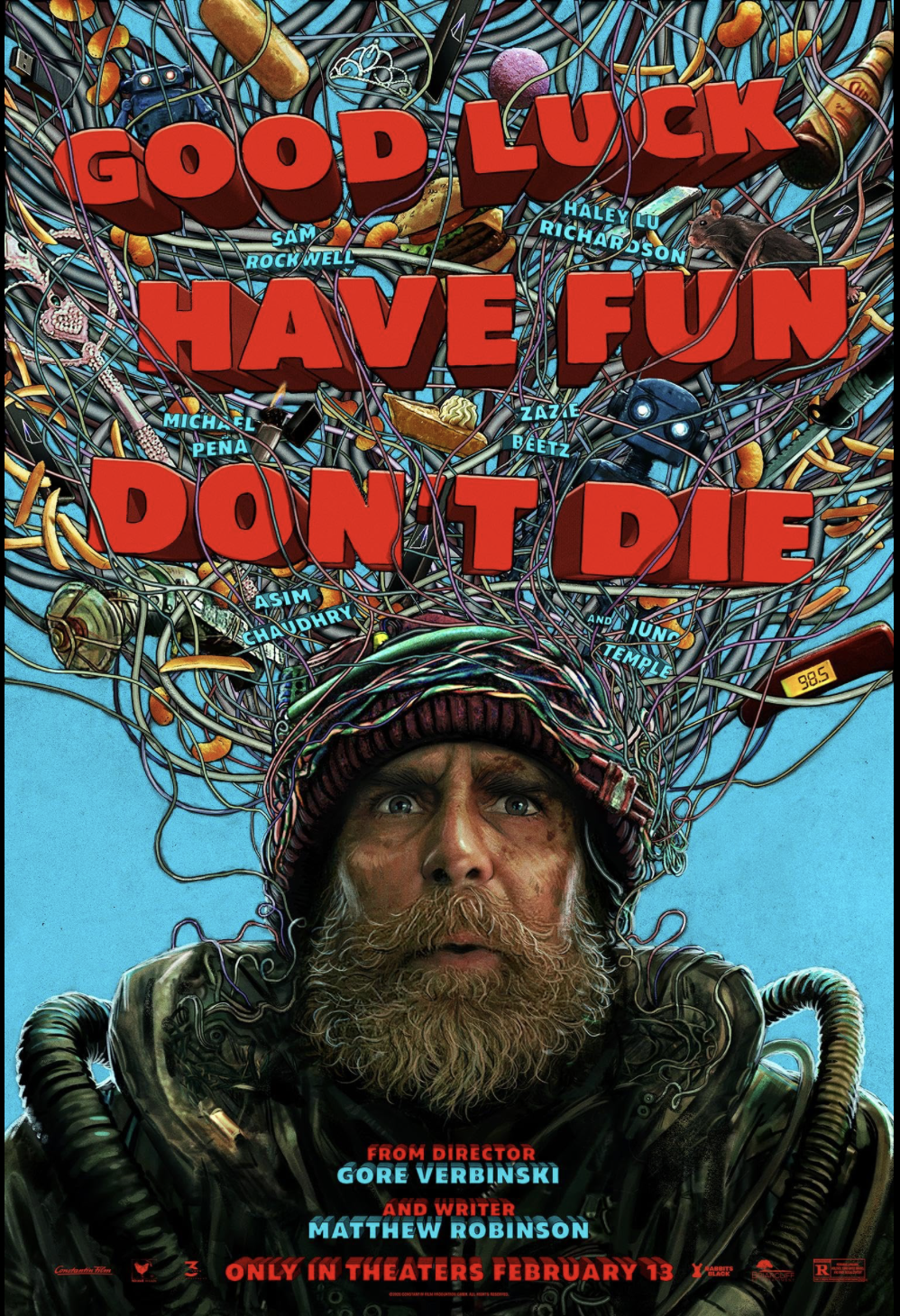
Gore Verbinski is back. That was the main selling point for me (and I assume so many others) with the advent, announcement and release of Good Luck, Have Fun, Don’t Die - A manic sci-fi comedy that marks a grand return for the stalwart director after nearly ten years of absence. At its core, this is a movie about a Future Traveler (Sam Rockwell, with an inimitable intensity and bursting onto the opening scene with a monologue that could only ever be delivered by him) recruiting a bunch of average folk in a diner to help save the world from the advent of a singularity - an AI gaining sentience with apocalyptic results. What follows is a dark, comedic, absolutely bananas thrill ride that can only ever be described as gonzo, but one so unsubtly and infectiously appropriate for our time with disturbing implications. It’s my favourite film of the year so far, and I think it’ll remain that way for quite a while.
Essentially a full, screaming act of outrage against the current dark violence of real life horrors and the creeping discomfort of A.I ubiquitousness, screenwriter Matthew Robinson’s script is brought onto the page with a capability and speed that is so creative and unreal that it appropriately could never ever have been created by anything other than an emotional human mind. The film structures and expands its core ‘doomsday mission’ plot around several small vignettes (à la last year’s horror fare Weapons) that deepen the scenario and most importantly, the characters.
Chief among them are Ingrid, played with a beautiful rawness by Haley Lu Richardson - a young woman suffering from an unexplained affliction that makes her allergic to any and all technology - especially phones, which are this movie’s doomsday symbol in a scathing, almost old-timey clap-back against the current, addled state of social media and how children can use it. Additionally, the award-winning Juno Temple is a highlight: playing a single mother named Susan, she delivers a harrowingly emotional performance tinged with some of the most tonally whiplashed genre-fusion I’ve ever seen - touching on a dark topic that frankly needed to be addressed in a way like this. I was constantly alternating between shock and complete random laughter in her story, which concerns an unexplained turn following a tragedy in her life. Rounding out the group are the husband-wife duo of Mark (the lovely Michael Peña) and Rachel (Zazie Beetz, who has one of the funniest lines of the whole movie), two struggling teachers and an estranged couple who are thrust into battles involving but not limited to, rayguns, zombies, and mind control.
Frankly, Good Luck defies conventional explanation because you’ll sound crazy trying to explain it to anyone. Its insanity deliberately touches on levels of ‘brain rot’ that’s been pervading a lot of media (indeed, much of it now A.I generated), but with such boundless, hand-crafted creativity and spirit, that despite risk of polarisation, drags viewers along for the ride. It just gets crazier, and crazier, but approaches all its topics - and there is a large breadth of them all tied to the complete hellhole of the socio-digital state of our current world - with a refreshing and kinetic sense of momentum that barely lets up. The film isn’t heavy on explanation - despite Rockwell’s future-splaining rambles, what little it offers about the current state of things (and beyond) is just to be accepted with aplomb, laughter, horror, realisation…but mostly ‘WTF’ as a hodgepodge of all of them.
“Digital life has pervaded all, consciousness and action and emotion are practically non-existent, everything is going insane around us and we’re not sure if we should stop it.†That’s essentially the thesis statement - delivered, again, with simmering outspokenness about the human element fighting for an ugly reality, one that is nonetheless being cannibalised by the wholly digitalised, illusory twin that it’s now creating. These are themes and arguments that don’t really intend to or become overt until the conclusive act of the film - possibly the only sore spot, as it trades in the manic creativity for a more mellow, time-stopping moment of explanation, exposition and pontification, that, while beautiful visually, does feel antithetical to the rest of it all (and does seem to draw out the film’s length a tad more than it should.) However, the film ends on a certain type of note: not brilliant, but executed just well enough to the point of decontextualisation. Of what came before it and what will come after, with signature gonzo style and function that leaves you guessing.
There can be comparisons made in function and intent, as with all art - Rockwell’s character himself references the Matrix and such familiar tropes are used, from the similarly time-travelling Terminator to the award-winning Everything Everywhere All At Once - but the whole thing is, again, differentiated by a complete, unending sense of insanity coupled with clear, crisp filmmaking. Verbinski has always been a visual storyteller - the film begins that way, focusing on symbols and objects in the diner as all hell breaks loose, visual telegraphing in full effect. The lighting is subtle but well-emphasised, the hi-concept nature of so many things executed beautifully for the meagre $20 million budget, and there is one moment - one moment - in the film, that’s so disgustingly, nightmarishly insane that it left me on the floor in stitches as what it introduced just kept on emphasising its own ridiculousness more and more and more. That’s all I want to say about it, but believe me, you’ll know it when you see it.
Such concepts and others are executed with a kinetic but smart camera style - one of the key highlights which plays with this involves a loose brake pedal on a car and the violent conclusions that follow. There are also some signature Verbinski touches - from the greebly outfit that Rockwell wears - with all its dials and weird piping - to the sense of scale being much larger than it actually is, special effects that are again astoundingly economical, and my personal favourite: a bunch of cute little robots and their antics that gave me wonderful flashbacks to his animated opus Rango. They too, however, devolve into insanity just as fast as the rest of the film.
It’s not content with stopping, with explaining. It just is, and a lot of the frankly overwhelming amount of ideas and concepts - which may seem to some as just weird for the sake of weird - need to be accepted. But I believe there’s a point to this, that all ties in with the central conceit of the film and the madness of our current reality; all the weird and awful things happening even as I write this. The film doesn’t even seem that far off. It’s scarily prescient regarding certain elements that have sometimes even happened in real life (note that the original script was written in 2017, and had to be both revised and simultaneously rushed into production given how fast things are moving.) The supposed yells of its message might be a bit much for some, but what is happening around us is no time for subtlety, when reality is outdoing fiction in terms of horrifying insanity. Verbinski and Robinson have recognised that and run everywhere with it, but, despite it all they still have an element of grounding; the aforementioned stunning core cast, who serve as a key counterweight to the film’s ‘throw it all at the wall’ approach with pathos and a sense of disbelief tantamount to our own.
In essence, Good Luck is a one hundred mile-per-hour train rushing at you, surrounded by colourful balloons, warhorses, confetti (another thing which has ‘creative’ implications in the film) and loudly yelling for everyone to ‘WAKE UP.’ It may not, ultimately, provide all the answers, both in its thesis and its neo-apocalyptic, inching closer world, but the simple fact of the matter is that it’s not a film here to do that. Much like the Future Traveler himself, it’s here to warn, protest, make us realise what we’re living in; a call to action, perhaps. Of what A.I, digitalisation, and reality’s effects can do to the perception and devolution of our own lives - lives which are much more than we can ever value.
It’s good to have a film like this here now, and by one of the finest and most undervalued directors of the modern age no doubt. It’s necessary. It’s welcome. There’s a particular scene in Susan’s subplot where the effect of what the people in this movie have done to themselves emerges in full effect - and what they’ve done to cope. It feels like something you’d never, ever see in a film because no one could ever approve it. A deep, dark thought mixed with morbid humor that’s barely passable. But I laughed anyway. I laughed loudly, and with quite a bit of innermost pain at what all’s happened and been happening in our world, a world that - blurring fiction and reality - shows intense difficulty in trying to be better. It’s not a prompt we can just feed into an A.I like everything else these days: ‘make everything better’. As much as I’m sure so many would want it to be.
We’re still here, and for now, all that’s left to say for our fates and our choices in regards to everything the film touches on right as we experience it…is of course one simple, devil-may-care epithet.
Good Luck. Have Fun. Don’t Die.
FINAL SCORE: 4.5/5